If you’ve searched for Mulank, Bhagyank, Driver Number, or Conductor Number, you may have noticed that different numerology websites use different names. This can make it difficult to understand whether these are four different numbers or simply different terms for similar calculations.
The easiest way to understand the difference is to look at what part of your date of birth is used.
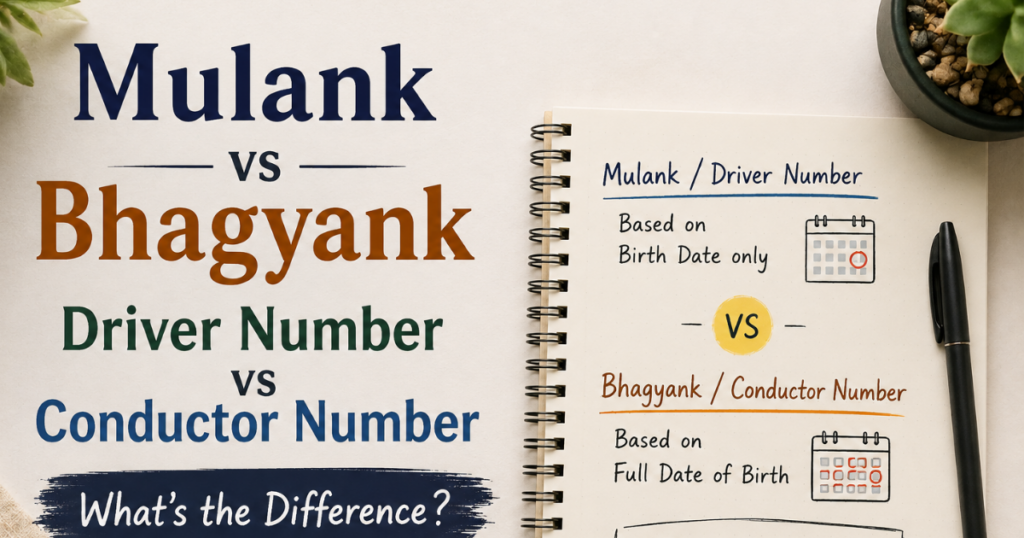
Mulank and Driver Number are calculated from your birth date only. Bhagyank and Conductor Number are calculated from your complete date of birth.
Let’s understand each number with a simple example.
Mulank vs Bhagyank vs Driver Number vs Conductor Number
The basic difference can be understood from this table:
| Number | Calculated From | Commonly Associated With |
|---|---|---|
| Mulank | Birth date only | Personality and natural tendencies |
| Driver Number | Birth date only | Behaviour and personality |
| Bhagyank | Complete date of birth | Life direction and destiny |
| Conductor Number | Complete date of birth | Overall life path |
So, if you want to remember it quickly:
Birth date → Mulank / Driver Number
Full date of birth → Bhagyank / Conductor Number
The names can vary depending on the numerology system or practitioner, but the calculation method is the easiest way to understand the difference.
What Is Mulank?
Mulank (मूलांक) is also known as the Root Number or Psychic Number in Indian numerology. It is calculated using only the date of birth, so your birth month and year are not included.
For example, if you were born on the 28th, add the two digits of your birth date: 2 + 8 = 10. Then reduce 10 to a single digit: 1 + 0 = 1. So, your Mulank is 1.
In numerology, Mulank is commonly associated with your personality, natural behaviour, instincts, habits, and immediate reactions. Since it is calculated from your birth date, your Mulank remains the same throughout your life.
Mulank Numbers and Birth Dates
The nine Mulank numbers are commonly connected with the following birth dates:
| Mulank | Birth Dates |
|---|---|
| 1 | 1, 10, 19, 28 |
| 2 | 2, 11, 20, 29 |
| 3 | 3, 12, 21, 30 |
| 4 | 4, 13, 22, 31 |
| 5 | 5, 14, 23 |
| 6 | 6, 15, 24 |
| 7 | 7, 16, 25 |
| 8 | 8, 17, 26 |
| 9 | 9, 18, 27 |
These associations are part of numerology traditions and should be understood as numerological interpretations rather than scientific measurements.
What Is Bhagyank?
Bhagyank (भाग्यांक) is commonly known as the Destiny Number. Unlike Mulank, it is calculated using your complete date of birth, including the day, month, and year.
For example, suppose your date of birth is 28/09/1996. Add every digit of your date of birth: 2 + 8 + 0 + 9 + 1 + 9 + 9 + 6 = 44. Then reduce 44: 4 + 4 = 8. So, your Bhagyank is 8.
In numerology, Bhagyank is commonly associated with your life direction, career, opportunities, challenges, and overall life path. In simple terms, Mulank uses only the day you were born, while Bhagyank uses your entire date of birth.
What Is Driver Number?
Driver Number is a term used in some Indian numerology systems for the number calculated from your birth date only. The calculation is the same basic process used for Mulank.
For example, if you were born on the 28th, calculate 2 + 8 = 10, and then 1 + 0 = 1. Your Driver Number is 1 under this calculation method.
This is why you may see Driver Number and Mulank used for the same birth-date-based calculation. The main difference is the terminology and the numerology framework in which the term is being used.
What Is Conductor Number?
Conductor Number is calculated using your complete date of birth, including the day, month, and year. It follows the same basic full-date calculation described for Bhagyank.
For example, if your date of birth is 28/09/1996, add all the digits: 2 + 8 + 0 + 9 + 1 + 9 + 9 + 6 = 44, and then 4 + 4 = 8. Your Conductor Number is 8.
Under the calculation method discussed here, Conductor Number and Bhagyank produce the same result. Again, the difference is mainly in the terminology used by different numerology systems.
Mulank, Bhagyank, Driver and Conductor: Different Names Explained
This is where most of the confusion comes from. One website may use Mulank and Bhagyank, while another may use Driver Number and Conductor Number.
Different numerology traditions and practitioners use different terminology. Because of this, the name alone does not always tell you how a number is calculated.
A simple comparison looks like this:
| Numerology Terminology | Birth-Date Number | Full-DOB Number |
|---|---|---|
| Indian/Vedic numerology | Mulank | Bhagyank |
| Some GLA-style systems | Driver Number | Conductor Number |
| Western numerology | — | Life Path Number |
So, when comparing two numerology calculators, it is better to check the calculation method rather than only comparing the names.
Mulank vs Bhagyank: What’s the Difference?
The main difference between Mulank and Bhagyank is simple: they use different parts of your date of birth.
Mulank is calculated from your birth date only, while Bhagyank is calculated from your complete date of birth. This means the month and year have no role in the basic Mulank calculation, but they are included when calculating Bhagyank.
| Factor | Mulank | Bhagyank |
|---|---|---|
| Calculated from | Birth date | Complete date of birth |
| Month included? | No | Yes |
| Year included? | No | Yes |
| Commonly associated with | Personality and instincts | Life direction |
| Also known as | Root Number | Destiny Number |
So, if someone asks you for the difference in one sentence, you can simply say:
Mulank is based on your birth date, while Bhagyank is based on your complete date of birth.
Driver Number vs Conductor Number
The difference between Driver Number and Conductor Number follows the same pattern.
Driver Number is calculated from your birth date, while Conductor Number is calculated from your complete date of birth. In the framework discussed here, Driver Number corresponds to Mulank, while Conductor Number corresponds to Bhagyank.
| Factor | Driver Number | Conductor Number |
|---|---|---|
| Calculated from | Birth date | Complete date of birth |
| Corresponds to | Mulank | Bhagyank |
| Month included? | No | Yes |
| Year included? | No | Yes |
| Commonly associated with | Personality and behaviour | Overall life direction |
This means you generally don’t need to perform four completely different calculations. You first need to know whether the system is asking for your birth date or your complete date of birth.
How to Calculate These Numbers
The easiest way to understand the difference is to calculate all four numbers using one date of birth.
Let’s use 28 September 1996, written as 28/09/1996.
Mulank
For Mulank, use only the birth date:
2 + 8 = 10
1 + 0 = 1
Therefore, Mulank = 1.
Driver Number
Driver Number uses the same birth-date calculation:
2 + 8 = 10 → 1 + 0 = 1
Therefore, Driver Number = 1.
Bhagyank
For Bhagyank, use the complete date of birth:
2 + 8 + 0 + 9 + 1 + 9 + 9 + 6 = 44
Then:
4 + 4 = 8
Therefore, Bhagyank = 8.
Conductor Number
Conductor Number uses the complete date again:
2 + 8 + 0 + 9 + 1 + 9 + 9 + 6 = 44 → 4 + 4 = 8
Therefore, Conductor Number = 8.
Final Result
| Number | Result |
|---|---|
| Mulank | 1 |
| Driver Number | 1 |
| Bhagyank | 8 |
| Conductor Number | 8 |
This example shows why the four names can be confusing. Under the calculation method discussed here, the four terms lead to two basic numerical calculations: one based on the birth date and another based on the complete date of birth.
Can Mulank and Bhagyank Be the Same?
Yes, Mulank and Bhagyank can sometimes be the same number.
This happens because the two numbers are calculated differently, but both calculations can still reduce to the same final digit.
For example, someone may have a Mulank of 5 and a Bhagyank of 5. Some numerology practitioners may interpret this as an alignment between personality-related qualities and broader life-direction themes.
However, this is a numerological interpretation and should not be treated as a scientifically proven result.
How to Use Mulank and Bhagyank Together
Many people who follow numerology prefer to look at Mulank and Bhagyank together rather than focusing on only one number.
Mulank is commonly used to understand personality, instincts, habits, and natural behaviour. Bhagyank is generally used to explore broader themes related to life direction, career, opportunities, and long-term goals.
Looking at both numbers can therefore provide a broader numerology-based interpretation.
At the same time, it is better to treat numerology as a self-reflection tool rather than a scientifically proven method for predicting your future. Important decisions should also consider practical information and professional advice.
Calculate Your Life Path Number
Want to find your Life Path Number without doing the calculation manually?
Use our free Life Path Number Calculator. Enter your complete date of birth to calculate your Life Path Number quickly and easily.
Final Thoughts
Mulank and Driver Number are based on your birth date, while Bhagyank and Conductor Number are based on your complete date of birth. The names may differ across numerology systems, so always check the calculation method before comparing results.